

With less than 40 days to go before the 2026 FIFA World Cup in the United States, Canada, and Mexico kicks off, 175 countries and regions have already secured broadcasting rights. However, negotiations in China have hit a dramatic turning point after six months of stalemate. China Central Television (CCTV) has firmly rejected FIFA’s exorbitant asking price, holding the line on its budget without compromise.
Within just 24 hours of the news breaking, what began as a commercial negotiation between the media and sports industries exploded into a full-blown public debate. Beneath the seemingly calm surface, a host of opportunistic voices emerged, and at the epicenter of the storm, Chinese fans have finally spoken their minds.
The root of this dispute is not that CCTV is unwilling to spend money on the World Cup, but that FIFA’s unrealistic demands have crossed the line of fair commercial cooperation and challenged the perceived value of the Chinese market.
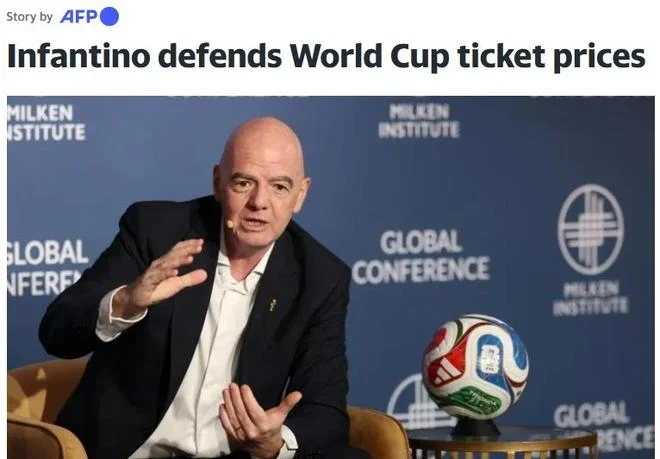
According to reports from authoritative media outlets like Beijing Daily, FIFA’s initial asking price for the broadcasting rights in mainland China for this World Cup was between $250 million and $300 million—equivalent to approximately 18 billion to 21 billion RMB. This figure is nearly double the cost of broadcasting rights for the 2022 Qatar World Cup and approaches the combined total for the 2018 and 2022 tournaments.
What makes this even more unacceptable is the blatant double standard in pricing. For the same tournament, FIFA offered India a package deal for two World Cups at just $35 million, or about $17.5 million per tournament. That means China’s initial price was 17 times higher than India’s—for identical content, simply because of different markets. This selective pricing reveals a condescending attitude aimed at exploiting what some see as a market with deep pockets but little bargaining power.
Throughout six months of negotiations, CCTV has maintained restraint and reason, offering a budget between $60 million and $80 million—a figure that aligns with the actual commercial value of the domestic market while considering the public broadcaster’s role and fans’ viewing rights. Even after FIFA twice reduced its asking price to between $120 million and $150 million, it still far exceeded CCTV’s bottom line, bringing talks to a complete impasse.
When news of CCTV’s rejection broke, the public reaction within a single day proved more dramatic than any World Cup script.
First came a wave of naysayers. Some fueled panic about Chinese fans missing out on live World Cup broadcasts, accusing CCTV of being stingy and disregarding fans’ needs. Others dredged up past broadcasting history to create a sense of doom, as if without CCTV’s coverage, the World Cup would vanish from Chinese lives. The implication was clear: accepting the sky-high price was the only way to prove devotion to football.
Then, various speculators jumped in. Overseas streaming platforms capitalized on the buzz, promoting their international viewing channels under the guise of “exclusive broadcasts,” even circulating pirated streaming links while ignoring copyright protection and user data security. Some self-media accounts tried to manipulate the narrative, spreading false claims that “FIFA has completely given up on the Chinese market,” all while hawking so-called “viewing guides” to attract clicks and traffic.
Most absurd were the condescending arguments. Some compared China’s market to those in Europe and the United States, insisting that China should be charged at tier-one market rates, conveniently ignoring the mature pay-per-view systems in those regions or CCTV’s commitment to free broadcasts. Others accused Chinese fans of being unwilling to pay for their passion, deliberately overlooking the fact that fans are not opposed to spending on football but are against unreasonable premiums and discriminatory pricing.
Even more bizarre were those who framed the standoff as a matter of “strategic vision,” as if accepting the inflated price would demonstrate China’s market strength. But true strength is never about blindly spending money; it’s about having the courage to say no to unfair rules.
In just 24 hours, these voices, though seemingly diverse, shared a common logic: they either treated the World Cup as a tool to harvest traffic and profits or clung to the illusion that international events are above all else. They forgot that the essence of the World Cup is football itself, and that love for the game should never be held hostage by inflated pricing or become a punching bag for arrogant capital.
In stark contrast to this noise, Chinese fans have shown unprecedented clarity and unity.
Across major social media platforms, rather than complaints and blame, there has been a chorus of support for CCTV. Fans are shouting, “We would rather not watch than be taken for fools.”
This clarity does not mean their passion for football has faded. It means Chinese fans have finally seen through the game’s commercial nature and are no longer willing to pay for capital’s arrogance and prejudice.
Everyone remembers the irreplaceable role the World Cup has played in Chinese fans’ hearts. From CCTV’s first broadcast in 1978, when blurry black-and-white TV images introduced football to millions of Chinese, to the 2002 Korea-Japan World Cup, when the national team made its debut in the finals, the whole country cheered with tears—it became a generation’s youth memory. Then, every four years, the World Cup arrived like an old friend, accompanying fans through summer nights with beer and cheers, weaving countless stories of passion.
This decades-long love is precisely what FIFA counted on to demand such high prices. They assumed that with the world’s largest fan base and nearly half of global viewing hours, the Chinese market would eventually cave in for love of the game.
But they were wrong. This time, Chinese fans refused to be emotionally manipulated. They are more clear-headed than ever.
Fans understand that if they cave to the exorbitant price now, the domino effect will ultimately hurt ordinary viewers. If CCTV, as a public broadcaster, shoulders such high copyright costs, the burden will either be passed on to advertisers, filling broadcasts with intrusive ads, or force a shift to pay-per-view, turning what was once a free football feast into a luxury accessible only to those who can pay. Recent examples are telling: during the 2024-2025 World Cup qualifiers for the national team, some matches adopted a pay-per-view model, sparking widespread backlash.
No one wants to see the quadrennial World Cup become another tool for capital exploitation, nor their passion turned into a bargaining chip.
Fans also recognize that this isn’t just about money. The 17-fold price gap reflects undisguised discriminatory pricing and FIFA’s arrogant assumption that China cannot live without the World Cup. But the truth is, the World Cup needs China more than China needs it. During the 2022 Qatar World Cup, Chinese viewers accounted for 49.8% of global digital viewing hours, and Chinese sponsors led the world in investment. Without the Chinese market, FIFA’s ambitious $11 billion revenue target would be impossible.
Those who criticize fans or stoke panic will never understand that Chinese fans’ love for football is not tied to any single World Cup broadcast. It won’t disappear just because they miss a few games. When thousands flock to village-level football matches like “Cun Chao,” when grassroots football events go viral, when more people step onto fields to cheer for local talent, it’s clear that Chinese fans’ passion is rooted in the sport itself, not in capital-driven commercial spectacle.
This brief 24-hour storm has exposed the true faces of opportunists and revealed the authentic voice of Chinese fans.
We love the World Cup. We love the running and passion on the green field, the stories of miracles and perseverance. But we will not pay for unreasonable pricing, we will not compromise for discriminatory double standards, and we will not allow our love to become a tool for profit.
